What Is the Average Mortgage in Australia? (2026 Update)
13 July 2025
The average new owner-occupier home loan in Australia is $735,000 as of the March quarter 2026, according to the Australian Bureau of Statistics — up from around $660,000 a year earlier. First home buyers borrow about $592,000 on average. At a 6.00% p.a. interest rate over 30 years, a $735,000 loan means monthly repayments of roughly $4,400.
Here is what sits behind those numbers: how deposits change what you borrow, how the average differs by state, what interest rates do to repayments, and how renting compares.
How Big Is the Average Australian Mortgage in 2026?
ABS Lending Indicators for the March quarter 2026 put the average new owner-occupier loan at $735,000 nationally. That average covers the whole country — what you actually borrow depends heavily on where you buy, your deposit, and your borrowing power. The RBA cash rate sits at 4.35% as of July 2026, held at its June meeting after three consecutive rises earlier in the year, which has kept borrowing costs front of mind for buyers.
Does a Lower Deposit Decrease the Average Mortgage?
No — a lower deposit increases the amount you need to borrow, not the other way around. Here is why:
- Higher Loan-to-Value Ratio (LVR): your deposit determines your LVR. A 20% deposit means an 80% LVR; a 5% deposit means a 95% LVR. The less you put down, the more you borrow.
- Lenders Mortgage Insurance (LMI): if your deposit is under 20%, most lenders require LMI — often tens of thousands of dollars, protecting the lender rather than you. LMI is frequently added to the loan, increasing the mortgage further.
- Interest rates: lenders can price higher-LVR loans as riskier, sometimes with slightly higher rates than loans with a 20%+ deposit.
Low-deposit loans and government schemes like the Home Guarantee Scheme make it possible to enter the market with less upfront, but they typically mean a larger loan and higher total cost over its life.
How Does the Average Mortgage Compare to House Prices?
The average mortgage tracks house prices, and prices keep climbing. The national mean dwelling price passed $1 million for the first time during 2025 (ABS), and the total value of Australia's dwelling stock rose a further 11.9% in the year to March 2026, reaching $12.8 trillion. Against an average new loan of $735,000, that gap is what your deposit has to cover — a 20% deposit on the roughly $920,000 property behind an average loan is about $184,000.
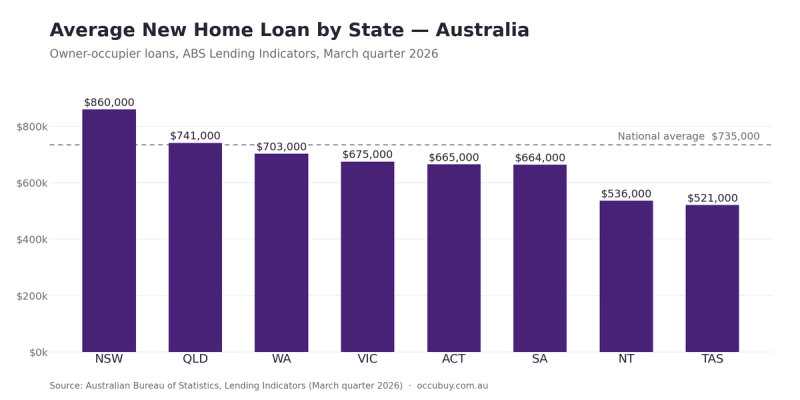
What Is the Average Mortgage in Each State?
Average new owner-occupier loan sizes for the March quarter 2026 (ABS), with indicative monthly repayments at 6.00% p.a. over 30 years, principal and interest:
- Australia overall: $735,000 — about $4,407 per month
- New South Wales: $860,000 — about $5,156 per month
- Queensland: $741,000 — about $4,443 per month
- Western Australia: $703,000 — about $4,215 per month
- Victoria: $675,000 — about $4,047 per month
- Australian Capital Territory: $665,000 — about $3,987 per month
- South Australia: $664,000 — about $3,981 per month
- Northern Territory: $536,000 — about $3,214 per month
- Tasmania: $521,000 — about $3,124 per month
Source: ABS Lending Indicators, March quarter 2026. Repayments are indicative only, calculated at 6.00% p.a. over 30 years, principal and interest.
Borrowing in Sydney typically means a mortgage around $340,000 larger than in Hobart — and roughly $2,000 more in repayments every month.
How Do Interest Rates Change Repayments?
Even a small rate change moves your monthly repayment substantially. On the average $735,000 loan over 30 years, principal and interest:
- 5.50% p.a. — about $4,173 per month
- 6.00% p.a. — about $4,407 per month
- 6.50% p.a. — about $4,646 per month
- 7.00% p.a. — about $4,890 per month
A single percentage point adds roughly $480 a month — nearly $5,800 a year. With the cash rate at 4.35% after 2026's rises, stress-testing your budget against higher rates matters more than ever.
Is It Cheaper to Rent or Pay a Mortgage?
In most Australian capital cities, monthly repayments on an average new mortgage currently exceed the median rent for a comparable home — the gap is widest in Sydney. Renting usually wins on monthly cash flow and flexibility.
Homeownership wins the long game: every repayment builds equity in an appreciating asset, while rent builds none. Owners also lock in stability against rent increases — national rents have climbed steeply alongside property prices.
The real question for most renters is not rent versus mortgage — it is how to bridge the deposit gap while paying rent. That is the specific problem Occubuy exists to solve.
Frequently Asked Questions
What is the average mortgage in Australia in 2026?
The average new owner-occupier home loan in Australia is $735,000 as of the March quarter 2026, according to ABS Lending Indicators. That is up from around $660,000 a year earlier, driven by rising property prices across most states.
What is the average monthly mortgage repayment in Australia?
On the average new loan of $735,000, monthly repayments are about $4,407 at 6.00% p.a. over 30 years (principal and interest). At 6.50% the same loan costs about $4,646 a month; at 5.50%, about $4,173.
What is the average first home buyer loan in Australia?
First home buyers borrowed about $592,000 on average in the March quarter 2026, based on ABS lending commitments data. That is roughly $143,000 less than the all-buyer average, reflecting cheaper entry properties and tighter borrowing capacity.
Which state has the largest average mortgage?
New South Wales has Australia's largest average new owner-occupier loan at $860,000 (March quarter 2026, ABS) — about $125,000 above the national average. Tasmania has the smallest at $521,000.
What is the RBA cash rate right now?
The RBA cash rate is 4.35% as of July 2026. The Reserve Bank held the rate at its 16 June 2026 meeting after three consecutive rises earlier in the year. Check rba.gov.au for the latest decision, as this changes through the year.
How much deposit do I need for an average Australian mortgage?
A 20% deposit on the property behind an average $735,000 loan is roughly $184,000. Government schemes such as the Home Guarantee Scheme allow eligible buyers to purchase with as little as 5% deposit without paying LMI, though this means borrowing — and repaying — more.
Can my rent help me save a home deposit?
Yes. Occubuy converts rent payments into OccuPoints that accumulate toward a home deposit on properties in its network — at no cost, without changing how you pay rent. You can also import your past rent history for instant points, so years of rent you have already paid count toward your deposit.
Shrink the Mortgage You'll Need — Starting With This Month's Rent
The gap between the average mortgage and what renters can save is the hardest part of buying. Occubuy closes it from the rent side. With the free Occubuy app you get:
- OccuPoints on every rent payment — plus instant points for past rent you import — redeemable toward your deposit, reducing what you need to borrow.
- Budgeting and savings tools that build the borrowing power lenders assess you on.
- Connections to mortgage partners who can match a loan to your situation.
- Sarah, the AI homebuyer assistant, for questions about rates, deposits and readiness.
Download the Occubuy app today and put every rent payment to work on your mortgage-to-be.
Written by the Occubuy team. Last reviewed July 2026 — loan figures from ABS Lending Indicators (March quarter 2026) and the RBA (June 2026). Spot something out of date? Tell us at admin@occubuy.com.au.